According to Austrian newspaper Kronen Zeitung, and as has been confirmed by news outlets such as El Pais, EFE or RTÉ News, the EBU will organise an online extraordinary General Assembly in November to vote on the participation of Israel in Eurovision 2026.
The EBU “has never faced a situation like this before”
The information was sent to EBU members by a letter from Delphine Ernotte-Cunci, president of the EBU and of France Télévisions.
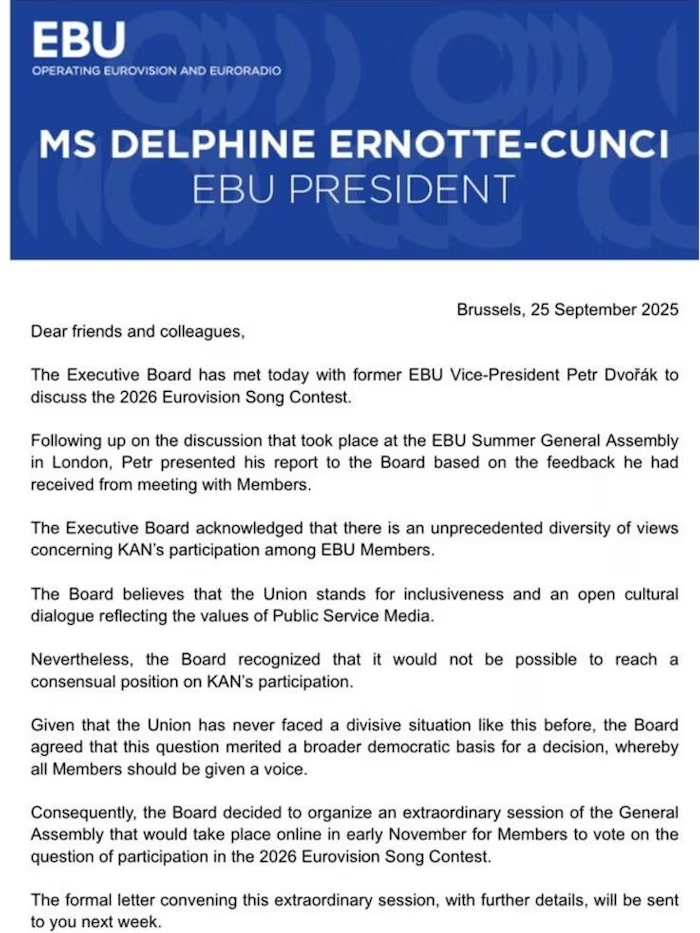
The content of the letter goes as follows :
Dear friends and colleagues,
Delphine Ernotte-Cunci, EBU President, 25/09/2025
The Executive Board has met today with former EBU Vice-President Petr Dvořák to discuss the 2026 Eurovision Song Contest.
Following up on the discussion that took place at the EBU Summer General Assembly in London, Petr presented his report to the Board based on the feedback he had received from meeting with Members.
The Executive Board acknowledged that there is an unprecedented diversity of views concerning KAN’s participation among EBU Members.
The Board believes that the Union stands for inclusiveness and an open cultural dialogue reflecting the values of Public Service Media.
Nevertheless, the Board recognized that it would not be possible to reach a consensual position on KAN’s participation.
Given that the Union has never faced a divisive situation like this before, the Board agreed that this question merited a broader democratic basis for a decision, whereby all Members should be given a voice.
Consequently, the Board decided to organize an extraordinary session of the General Assembly that would take place online in early November for Members to vote on the question of participation in the 2026 Eurovision Song Contest.
The formal letter convening this extraordinary session, with further details, will be sent to you next week.
The letter references the discussions and consultation which have been taking place since the London General Assembly of July 2025, and which have been managed by Petr Dvořák, from Czechia, who held a position as EBU Vice-President in 2021-2022.
Over the last few weeks, several broadcasters have shared their plans for 2026, with some ready to boycott if Israel participates next year. RTV SLO from Slovenia, RTÉ from Ireland, AVROTROS from The Netherlands and RTVE from Spain have clearly stated that they would withdraw, while RÚV from Iceland and RTBF from Belgium said they would wait until December to take a decision. This was made possible by the EBU extending the deadline to confirm Eurovision participation without financial penalties from October to December.
December was chosen because of the Geneva General Assembly planned to take place on 4-5 December, where the topic of Israel’s participation could have been discussed. The EBU’s Executive Board instead decided to hold an extraordinary General Assembly, where all members of the Union (including broadcasters not taking part in Eurovision) will likely be able to vote.
KAN reacts – and may be wrong on its legalities
Israel’s broadcaster, KAN, has reacted to the decision with the following statement.
Kan, the Israeli Public Broadcasting Corporation, expresses its firm hope that the Eurovision Song Contest will continue to uphold its cultural and non-political identity.
KAN’s statement on the EBU General Assembly vote, 25/09/2025
The potential disqualification of Israel’s public broadcaster KAN – one of the contest’s long-standing, popular, and successful participants – would be especially troubling ahead of the 70th edition of the song contest, which was founded as a symbol of unity, solidarity, and fellowship. Any such move could have wide-ranging implications for the competition and the values for which the EBU stands.
The EBU Statutes stipulate for a good reason that extraordinary decisions of this kind require a 75% majority of the General Assembly – an exceptional majority. We are confident that the EBU will safeguard the contest’s professional, cultural, and non-political character as it marks the historic 70 years milstone of uniting by music.
Is a super-majority needed to take a decision against KAN?
This section has been edited after confirmation of the rules by the EBU, as reported by The Times of Israel.
Not at all.
KAN references the EBU statutes: they hold that an EBU member or affiliate can only be expelled from the Union by a majority of 75% of the voting members present at a General Assembly (including blank and invalid votes, but not abstentions, assuming abstentions are allowed), and that 75% of the entire roster of members must be present or represented. This is from articles 5.9-5.10 of the Statutes.
Although the formal letter summoning the Assembly has not been sent yet, the letter from Delphine Ernotte-Cunci only mentions that it should vote on “the question of participation in the 2026 Eurovision Song Contest“, and not an exclusion of KAN from the EBU as a whole. The relevant article in the statutes seems to be Article 7.2.18:
7.2 The Executive Board:
EBU Statutes
- 7.2.18: takes, in accordance with Articles 5.6, 5.7 and 5.8, sanctions, which may consist of one or more of the following:
- […]
- a suspension, for no longer than three years, with respect to participation in specified meetings or activities, including Eurovision and/or Euroradio, other than sessions of the General Assembly, […]
The conditions for applying the present provisions are laid down in the Bye-Laws
It is not yet clear if this is the relevant passage, since Executive Board is not necessarily actively asking for KAN’s expulsion. It is likely that the applicable rules are laid down in the EBU Bye-Laws, which are not publicly accessible. The EBU has at least confirmed to The Times of Israel that a simple majority of 50% will be sufficient to take a decision.
A November resolution to the crisis
In any case, the EBU’s decision now creates a clearer timeline for the resolution of the current crisis. The date of the online meeting will likely be revealed next week, when the formal invitations are sent out.
After the meeting, KAN will either be allowed to take part in Eurovision 2026 in Vienna, or be expelled from the Contest for, seemingly, a year. Should it survive the vote, several broadcasters will likely act on their threat to withdraw and will be available to do so without financial penalties, which could set off a much bigger crisis ahead of the 70th anniversary of the Contest.
Do you think the EBU is taking the right decision by calling on the General Assembly to take a vote on the matter? Should members not involved in the Contest take part? Can this resolve the crisis, or will it make it worse? Tell us more in the comments below or on social media!
Be sure to stay updated by following @ESCXTRA on Twitter, @escxtra.bsky.social on Bluesky, @escxtra on Instagram, @escxtra on TikTok and liking our Facebook page for the latest updates! Also, be sure to follow us on Spotify for the latest music from your favourite Eurovision acts. As well as YouTube to see interviews and reactions to the latest Eurovision news.